Healthcare Is Changing
Is Your Care Management Model Ready?
HealthCore360 helps healthcare organizations bring physician-directed care management together within one operational platform—connecting what happens before, during and between physician visits.
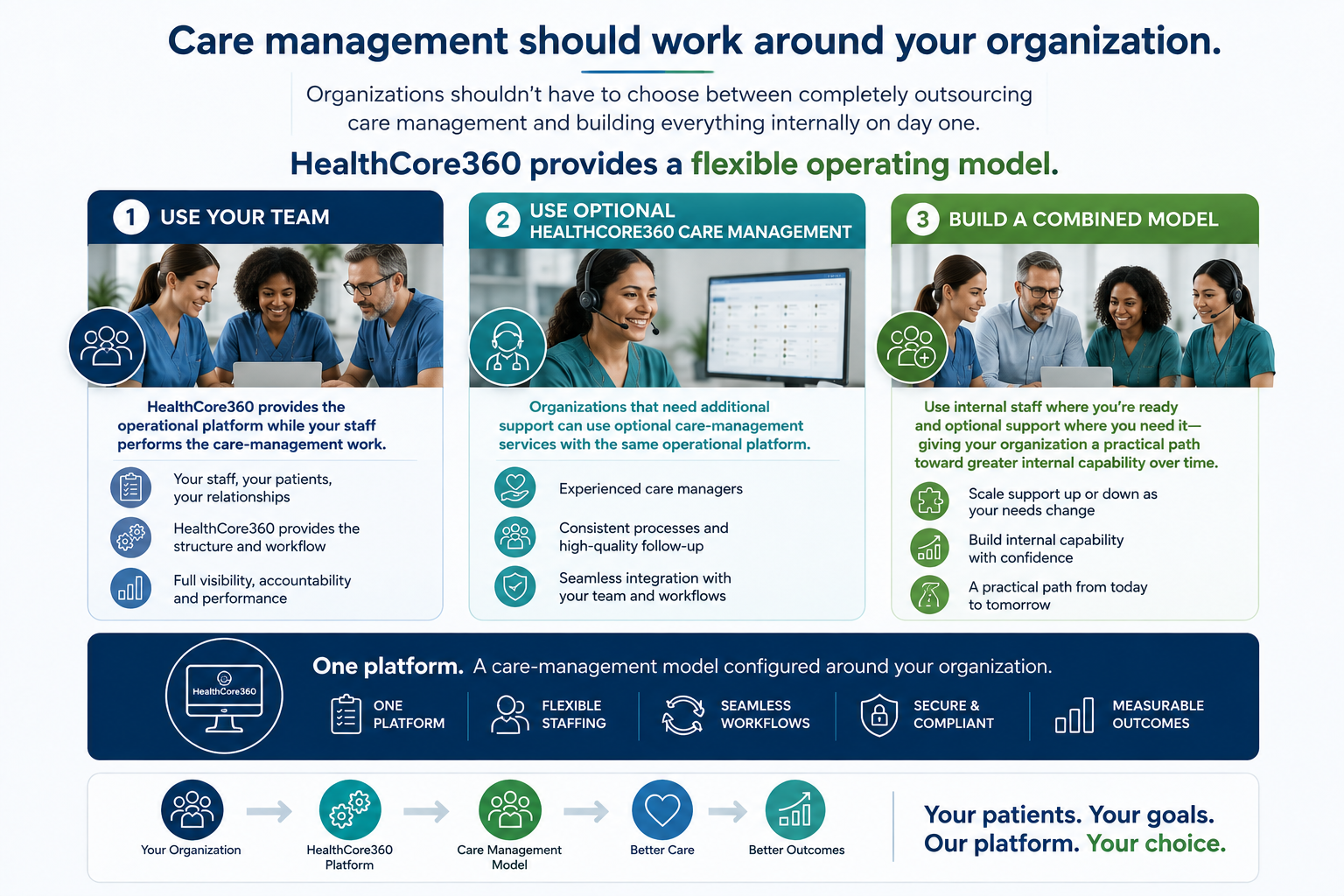
Use your own care-management team, our optional care-management services, or a combination of both.
Built for the care environment you have today—and designed to adapt as CMS and healthcare continue to change.
Know What Needs Attention — And What Happens Next
The challenge isn't simply collecting more patient information.
Healthcare organizations need to know:
Who needs attention?
What changed?
What needs to happen next?
Who is responsible?
Does the physician need to be involved?
Was the action completed?
What was the outcome?
HealthCore360 connects those questions to the physician's Plan of Care and the ongoing work of the care team.
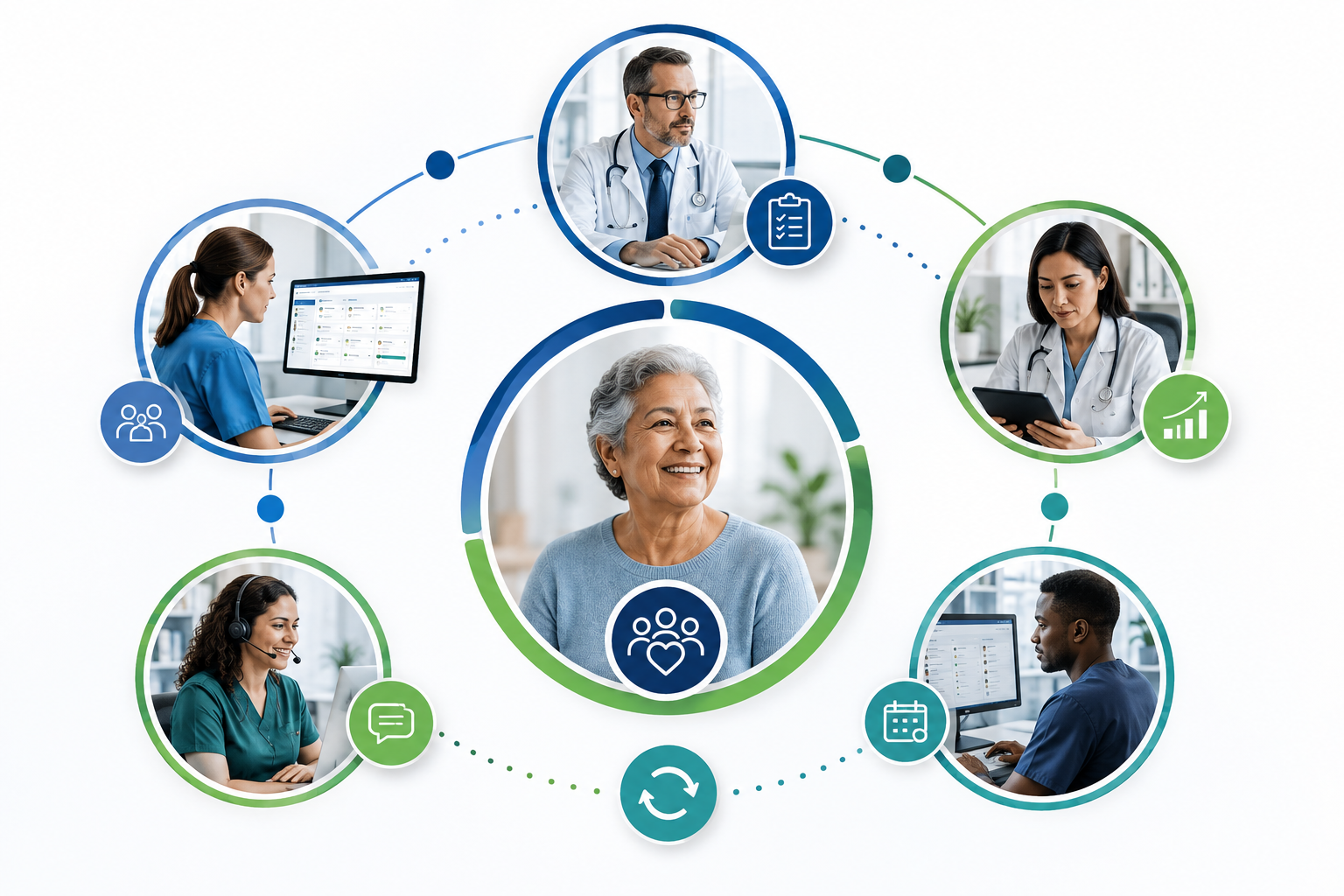
One Patient. One Connected Operational Story. Designed Around Your Organization.
Patients don't experience healthcare as separate programs.
A patient may move through Primary Care, specialty care, remote monitoring, chronic care management, hospitalization, transitional care, medication changes and referrals.
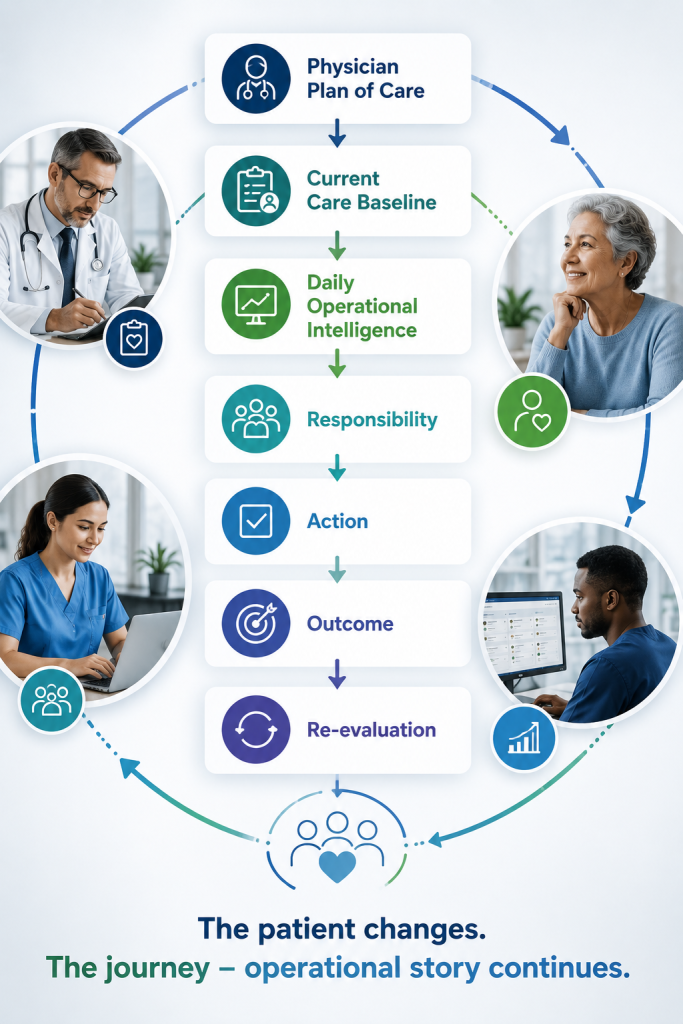
When the Patient's Care Changes, the Story Continues
A hospitalization or discharge should not create a disconnected care-management process.
When a patient transitions from an inpatient setting back to the community, Transitional Care Management (TCM) can become an active Care Event within HealthCore360.
HealthCore360 helps the care team organize and follow the transition:
Hospital/Discharge
↓
TCM Care Event Identified
↓
Open Care Sub-Task
↓
Required Transition Work & Follow-Up
↓
Medication and Care Changes Identified
↓
Physician Follow-Up
↓
Outcome Documented
↓
Current Care Baseline Re-evaluated
↓
TCM Completed — Patient's Ongoing Care Continues
The TCM episode may end.
The patient's operational story does not.
HealthCore360 helps keep those activities connected around the patient's changing care needs and physician direction.
We then introduce pathways :
HealthCore360 uses a common operational foundation that can be configured for different healthcare environments.
Primary Care
Support longitudinal physician-directed care across the patient's changing needs.
Specialty Care
Support specialty treatment, monitoring, referrals, PCP collaboration and care between specialist visits.
Health Systems
Connect operational care across physicians, practices, services and patient transitions.
ACOs & Value-Based Care
Turn population needs into patient-level responsibility, action and follow-through.
FQHCs & RHCs
Support coordinated care within the unique clinical and operational environment of community-based organizations.
Multi-Specialty Organizations
Maintain responsibility and continuity as patients move between specialties.
Remote Monitoring Should Lead to Care — Not Just More Data
Remote Patient Monitoring can provide valuable information about what is happening with a patient between physician visits.
Blood pressure, weight, pulse oximetry and other physician-ordered monitoring tools can help identify important changes—but collecting the reading is only the beginning.
HealthCore360 connects appropriate remote-monitoring information to the patient's ongoing operational care.
When something requires attention, the care team can understand:
What changed?
Does it matter to the patient's current Plan of Care?
Who is responsible for reviewing it?
What action is needed?
Does the physician need to be involved?
What was the outcome?
The result becomes part of the patient's continuing care story rather than remaining an isolated reading in a device portal.
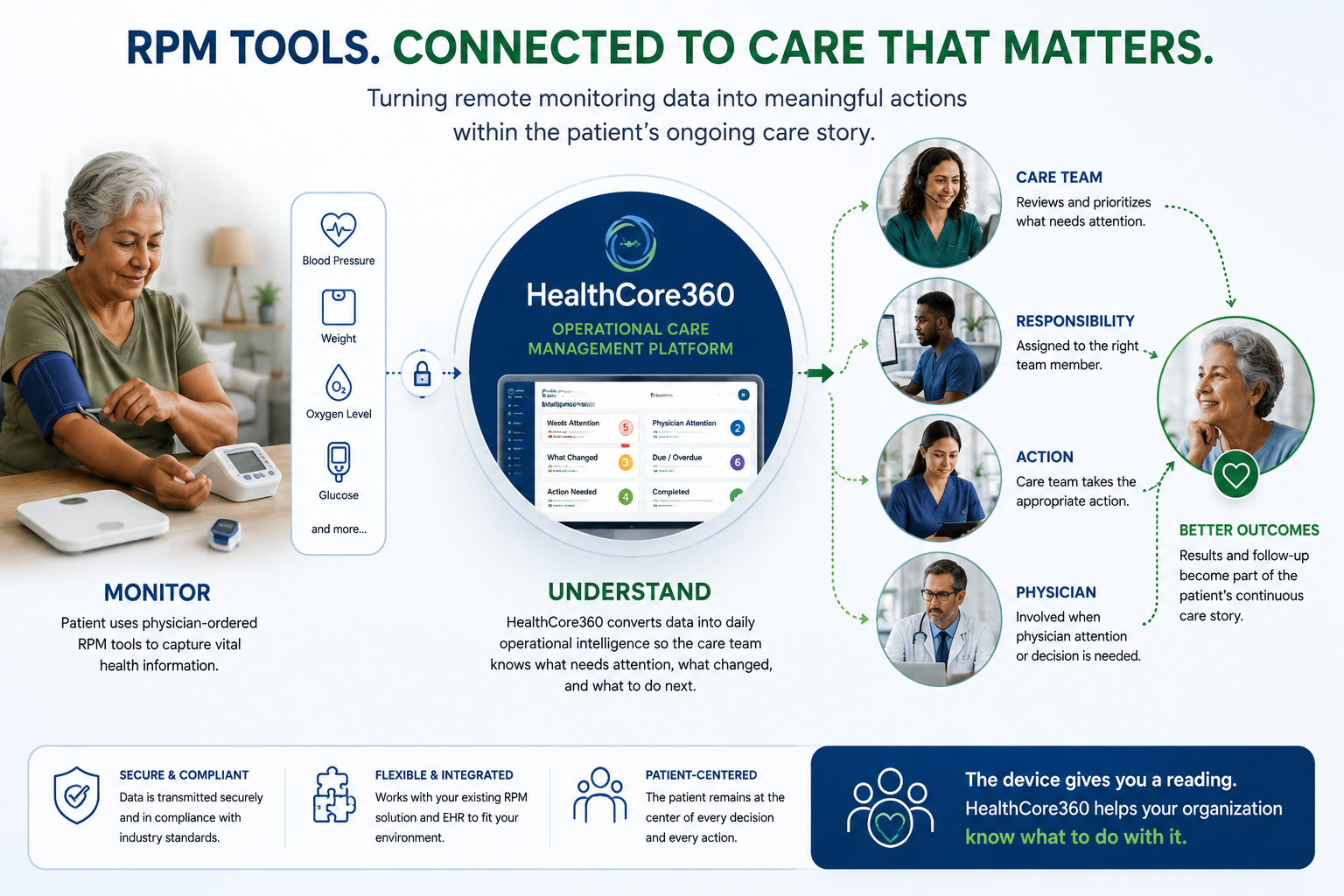
Device Flexible. Care Connected.
HealthCore360 is designed to work within the organization's monitoring environment.
Organizations may use their existing RPM solution or select monitoring tools appropriate for their patients and clinical programs.
HealthCore360 does not make the device the care model. It helps connect monitoring to the care that needs to happen.
Need RPM devices? HealthCore360 can also help organizations establish an appropriate device solution as part of their care-management model.
Your Team. Our Team. Or Both.
Built for Today's Healthcare — And What's Next
CMS change is part of how we think about operational care management.
CMS continues to change how healthcare organizations are paid and how physicians and organizations are expected to manage, coordinate and document care.
HealthCore360 follows those changes to help organizations evaluate:
What is changing?
What could it mean operationally?
What may physicians and staff need to do differently?
Is the organization's current care-management model prepared?
How should HealthCore360 configuration evolve?
We distinguish between current requirements, finalized future changes, proposed rules and CMS models so organizations can prepare without treating proposed policy as final.
Start With What You Need Today
You don't have to change everything at once.
Keep the EHR, clinical systems, devices, vendors and care teams that are working for your organization.
HealthCore360 provides the operational structure around the work that needs to happen.
Start with a specific problem.
Configure the appropriate pathway.
Use your staff, optional care-management support, or both.
Expand as your organization is ready.
What Does Care Management Need to Look Like for Your Organization Next?
Let's start with your current environment, the problems your physicians and staff are trying to solve, and where you want care management to go.
Then we'll determine whether HealthCore360 fits.